

Finding the right consultant SEO e-commerce specialist can help you turn your online store into a stronger source of organic traffic and sales. In 2026, US ecommerce businesses face growing competition, changing search behavior, and rising advertising costs. A skilled consultant can identify ranking issues, improve product pages, and build a practical strategy around your business goals.
Whether you run a Shopify store or a large online marketplace, the right expert can help you reach more potential customers. This guide explores the best ecommerce SEO consultants, their services, pricing models, and key differences. You’ll also learn how to choose an expert who supports sustainable organic traffic, technical SEO, and long-term growth.
1. What Does an Ecommerce SEO Consultant Do?
An ecommerce SEO consultant helps online retailers improve their visibility in search engines. They examine your website, research customer searches, and identify changes that could attract more qualified visitors. A skilled ecommerce SEO expert understands how product pages, category pages, site structure, and technical performance work together.
Their work often begins with an ecommerce SEO audit. They check whether search engines can find important pages and understand their content. They may also review keyword targeting, competitor strategies, product information, and website performance. After the audit, they create a prioritized plan based on business goals, available resources, and potential impact.
Core Responsibilities of an Ecommerce SEO Specialist
A specialist connects technical improvements with customer needs. Their responsibilities may include technical SEO audit work, keyword mapping, product page improvements, content planning, and internal linking. They may also review website indexing, canonical tags, duplicate URLs, and XML sitemap settings to help search engines discover the correct pages.
For example, imagine your store sells 5,000 products but receives little organic traffic. The consultant may discover that many product pages target similar keywords or remain difficult to crawl. They can recommend better page templates, clearer category structures, and more useful content. However, ask whether the consultant will implement these changes or simply provide instructions for your team.
2. Why Ecommerce Businesses Need an SEO Consultant in 2026

Online retailers face strong competition from major marketplaces, established brands, and smaller niche stores. Paid advertising can bring visitors quickly, but costs and competition can make long-term growth difficult. A focused ecommerce SEO strategy helps your business reach customers who are already searching for products you sell.
An experienced consultant can uncover missed opportunities across technical performance, content, and product discovery. They can also help you understand organic search visibility, improve qualified ecommerce organic traffic, and connect search performance with revenue growth. SEO takes time, though. Results depend on competition, website quality, implementation speed, and the strength of your existing online presence.
Key Benefits of Hiring an Ecommerce SEO Expert
The biggest benefit is having a clear plan instead of guessing what to fix. A consultant can identify weak category pages, missing product information, and technical errors that waste crawling resources. They can also improve ecommerce conversion rate optimization by finding gaps between what shoppers search for and what your landing pages deliver.
Consider a US retailer selling outdoor furniture. Its product pages may attract visitors, while category pages fail to rank for broader searches such as patio dining sets. A consultant could improve category content, refine internal links, and strengthen product discovery. These changes may bring more relevant shoppers without requiring the business to increase its advertising budget.
3. How We Evaluated the Best Ecommerce SEO Consultants
Choosing consultants requires more than checking search rankings or social media followers. A reliable comparison should consider ecommerce experience, technical knowledge, client evidence, service delivery, and pricing transparency. It should also distinguish verified results from claims that a provider makes about its own work.
For this guide, the evaluation framework focuses on factors that US businesses can investigate before hiring. The names discussed later are candidates to research, not a claim that every provider has undergone independent testing. Before publication or hiring, verify current services, availability, client evidence, and pricing directly with each provider.
Evaluation Criteria and Scoring Methodology
A useful assessment starts with ecommerce specialization. The consultant should understand online catalogs, product feeds, category structures, and the technical challenges of ecommerce platforms. Experience with Shopify, WooCommerce, or Adobe Commerce may matter, depending on your store. Equally important are case studies that explain the starting point, actions taken, timeframe, and measurable results.
The following table provides a proposed scoring model. Use it only after evaluating every candidate against the same criteria. A consistent method makes comparisons more transparent and helps readers understand why one consultant may suit a particular business better than another.
| Evaluation criterion | Suggested weight |
| Ecommerce SEO expertise | 25% |
| Verified case studies and results | 20% |
| Technical SEO capabilities | 20% |
| Implementation and delivery support | 15% |
| Client feedback and reputation | 10% |
| Pricing transparency and communication | 10% |
| Total | 100% |
4. Top Ecommerce SEO Consultants and Experts in 2026
Finding the right consultant starts with understanding each provider’s strengths. Some specialize in ecommerce strategy and analytics, while others focus on international search, technical education, or enterprise websites. The most suitable choice depends on your store’s size, technical needs, budget, and internal team’s ability to implement recommendations.
The following professionals and businesses are potential candidates for your shortlist. Their inclusion does not mean they are objectively the top-ranked consultants in the United States. Review their current websites, services, case studies, and availability before deciding whether they fit your business.
Luke Carthy: Ecommerce SEO and Conversion Optimization
Luke Carthy is known for work involving ecommerce SEO, analytics, and conversion optimization. This combination may appeal to retailers that attract organic visitors but struggle to turn those visits into sales. His approach is relevant when search performance and the shopping experience need to be assessed together.
Visit Luke Carthy’s official website to review his current services and consulting arrangements. Before hiring, ask how he measures commercial outcomes, what deliverables your team will receive, and whether implementation support is available. Confirm current pricing directly because consulting fees can vary with project scope.
Aleyda Solis and Orainti: International and Strategic SEO
Aleyda Solis founded Orainti, a consultancy associated with strategic SEO and international search projects. Businesses expanding across countries may need guidance on language targeting, market-specific content, and complex website structures. Such projects require careful planning because mistakes can affect important pages across several markets.
Explore Orainti’s official website to confirm its current services and availability. Ask about experience with international ecommerce, migration planning, and large product catalogs. For US retailers entering new markets, the most useful engagement is one that connects technical recommendations with a realistic implementation roadmap.
Kristina Azarenko and MarketingSyrup: Technical SEO Education
MarketingSyrup is associated with technical SEO education and training led by Kristina Azarenko. This route may suit businesses that want to strengthen their internal team’s skills rather than rely entirely on external consulting. Training can help developers and marketers understand technical reports and prioritize fixes more confidently.
Visit MarketingSyrup’s official website to review its current offerings. Check whether the available service matches your needs because training, consulting, and hands-on implementation are different products. A course may build internal capability, but your team still needs time to apply what it learns.
Kevin Indig: SEO and Growth Strategy
Kevin Indig is known for work in SEO and growth strategy. His experience may be relevant to businesses looking for a broader view of organic acquisition, product-led growth, and search performance. However, general growth expertise does not automatically establish suitability for every ecommerce project.
Review Kevin Indig’s website for current work and service information. If you consider him for a retail project, verify current consulting availability and ask for evidence relevant to your business model. Specific ecommerce experience matters more than a well-known name alone.
Ecommerce SEO Specialists and Boutique Agencies
Independent specialists and boutique agencies may offer a closer fit for particular platforms, industries, or budgets. For example, a Shopify-focused consultant may understand the platform’s theme structure and common technical issues, while an enterprise team may have more experience with complex catalogs and international storefronts. Neither model is automatically better for every retailer.
When comparing additional candidates, review their official websites, client references, and documented results. Look for evidence that matches your needs rather than relying on broad promises. A consultant who has solved problems similar to yours may be more useful than one with a longer list of unrelated clients.
5. Best Ecommerce SEO Consultants Compared: Services, Pricing and Expertise
A comparison table makes it easier to narrow your shortlist. However, you should compare delivery models as well as expertise. One consultant may provide strategic recommendations, while another offers training or ongoing implementation. These differences affect the amount of work your team must complete after the engagement begins.
The table below summarizes the providers discussed in this guide. It does not assign unsupported ratings or unverified prices. Use the official websites to confirm current offerings, then request proposals that describe deliverables, timelines, reporting, and responsibilities.
| Consultant or provider | Main area to investigate | Potential fit | Pricing |
| Luke Carthy | Ecommerce SEO, analytics, CRO | Stores connecting search with conversions | Confirm directly |
| Orainti | Strategic and international SEO | Businesses with complex or international needs | Confirm directly |
| MarketingSyrup | Technical SEO education and training | Teams building internal skills | Depends on offering |
| Kevin Indig | SEO and growth strategy | Businesses needing broader growth guidance | Confirm directly |
| Boutique ecommerce specialists | Platform-specific or technical SEO | Retailers with defined needs | Depends on scope |
How to Match a Consultant to Your Business
A small US retailer may need help fixing indexation problems and improving a few high-value categories. A growing direct-to-consumer brand may need stronger content planning and better conversion measurement. An enterprise retailer may require migration support, international planning, or guidance across thousands of URLs. These businesses need different kinds of expertise.
Before choosing a provider, define your main problem and the resources available to solve it. Ask each candidate to explain their first priorities and how they would measure progress. This makes it easier to compare proposals based on expected work rather than impressive presentations or vague promises.
6. What Services Does an Ecommerce SEO Consultant Offer?
The scope of ecommerce SEO services varies by provider. Some consultants focus on audits and strategy, while others also help with implementation, content, and reporting. Understanding these differences helps you avoid paying for recommendations your team cannot act on. A written scope should clearly state what the consultant will deliver.
Strong online store SEO combines technical health, relevant content, useful navigation, and a good shopping experience. Depending on your needs, ecommerce website optimization may include product page improvements, keyword research, site architecture changes, structured data, and link acquisition. The right mix depends on the problems holding your store back.
Technical Ecommerce SEO Audits
A Technical SEO audit examines whether search engines can discover, crawl, render, and index important pages. Consultants may review Crawl budget optimization, Website indexing, Canonical tags, Duplicate URLs, Faceted navigation, Pagination optimization, URL structure, and XML sitemap configuration. These checks matter when a store has thousands of products or many automatically generated URLs.
The audit may also assess Core Web Vitals, Page speed optimization, mobile usability, and Website migration risks. A good report does more than list errors. It explains which issues matter most, why they matter, and how your developers should fix them. Ask for prioritized recommendations rather than a long export of technical warnings.
Ecommerce Keyword Research and Search Intent Mapping
Effective Ecommerce keyword research starts with understanding what shoppers want. Some searches indicate that a person is comparing products, while others suggest they are ready to buy. Consultants use Search intent and Keyword mapping to match relevant queries with the right landing pages and avoid unnecessary overlap.
For example, a store selling running shoes might target a broad category page for men’s trail running shoes. An individual product page can target a specific model and size range. This structure helps shoppers reach the right information. It also reduces the risk of several pages competing for the same search terms.
Product Page and Category Page Optimization
Product page SEO helps search engines and customers understand each item’s features, benefits, and purpose. Clear Product descriptions, accurate specifications, useful images, and well-organized information can improve the shopping experience. Consultants may also review Product variants to ensure that colors, sizes, and other options do not create confusing or redundant pages.
Meanwhile, Category page optimization focuses on broader groups of products. Well-structured Collection pages and Product category pages can answer common shopping questions and guide visitors toward suitable items. Consultants may improve headings, category copy, filters, and Internal linking so shoppers and search engines can navigate the catalog more easily.
Ecommerce Content Strategy and Link Building
A thoughtful Ecommerce content strategy supports shoppers at different stages of their buying journey. Buying guides, product comparisons, sizing advice, and practical tutorials can answer questions before a customer chooses an item. Useful content should provide original value rather than repeat generic descriptions that appear across competing websites.
Consultants may also plan Ecommerce link building and Backlink acquisition through relevant publications, product reviews, partnerships, and digital PR. The goal is to earn credible links that support discovery and authority. Be cautious of providers promising large numbers of links without explaining their methods, relevance, or quality controls.
AI Search Visibility and SEO Automation
Search discovery continues to evolve as users interact with AI-assisted tools. AI search visibility involves making useful, accurate information accessible to systems that may summarize products or recommend brands. Generative AI search, AI search optimization, ChatGPT product recommendations, and Perplexity search visibility are relevant emerging topics, but no consultant can guarantee a particular citation or recommendation.
Automation can also support repetitive tasks. AI-generated content, Automated content publishing, SEO workflow automation, Automated keyword research, and AI-powered SEO tools may help teams work more efficiently when used with proper review. Ecommerce SEO automation should not mean publishing unchecked material at scale. Human oversight remains important for accuracy, originality, product details, and brand voice.
7. How Much Does an Ecommerce SEO Consultant Cost?
Ecommerce SEO pricing depends on the consultant’s experience, the size of your website, and the work involved. A one-time audit usually has a different scope from ongoing consulting or a complex migration. US businesses should compare the full cost of getting recommendations implemented, not just the consultant’s fee.
Some providers publish fixed prices, while others prepare custom proposals after reviewing a website. The table below explains common payment models. It is a comparison of engagement types, not a verified list of current US market rates. Request a written quote before budgeting for a specific project.
| Pricing model | Typical payment structure | What to clarify |
| Hourly consulting | Payment for booked time | Hours included and response times |
| Fixed-price audit | One agreed project fee | Audit scope and deliverables |
| Project-based consulting | Fee for a defined assignment | Milestones and exclusions |
| Monthly retainer | Recurring monthly payment | Ongoing work and reporting |
| Training or workshops | Fee per course or session | Access, support, and practical exercises |
What Influences Ecommerce SEO Consulting Fees?
A Large product catalog can require more analysis than a small store with a limited number of pages. Platform complexity, international expansion, development requirements, and the number of teams involved can also affect costs. A specialist working on a high-risk migration may charge differently from someone reviewing a few category pages.
Your total budget should include implementation, content production, developer time, and reporting where these are not included in the consulting agreement. Before signing, ask which tasks the consultant will perform and which tasks your team must handle. This simple step helps prevent unexpected expenses and delays.
How to Measure Ecommerce SEO Return on Investment
Start by recording your current organic traffic, qualified leads or sales, and conversion rates. Use Google Analytics 4 (GA4) and Google Search Console to understand how visitors arrive and interact with your site. Reliable Ecommerce conversion tracking helps you connect search activity with meaningful business outcomes instead of relying on rankings alone.
For example, a retailer may see more organic visitors after improving its category pages. However, if those visitors rarely purchase, the business should investigate product relevance, pricing, page experience, and checkout friction. Conversion rate optimization (CRO) complements SEO by helping more suitable visitors complete useful actions. Treat revenue changes carefully because promotions, seasonality, and inventory can also affect results.
8. How to Choose the Right Ecommerce SEO Consultant for Your Business
Choosing an SEO partner starts with a clear understanding of your biggest challenge. You may need a technical diagnosis, a content plan, help with a migration, or ongoing support for a growing catalog. The right SEO consultant for ecommerce should explain how their expertise addresses that specific need.
Look for transparent communication, realistic expectations, and evidence of relevant experience. Ask for examples of similar projects and find out who will implement the recommendations. A consultant who understands your business constraints can develop a more practical Ecommerce SEO strategy than someone who simply provides a standard checklist.
Questions to Ask Before Hiring an Ecommerce SEO Expert
Ask candidates which ecommerce platforms they know and what types of stores they have supported. Request relevant case studies and ask how they measured the results. You should also understand what happens after the audit, how often progress is reviewed, and whether the consultant works directly with developers or content teams.
A useful question is, “What would you investigate first on our website, and why?” The answer can reveal whether the consultant thinks critically about your situation. Strong candidates should explain their reasoning, identify uncertainties, and discuss trade-offs. Be cautious if every answer leads to the same expensive package or an unrealistic promise.
How to Review Case Studies and Client Results
A credible case study should explain the initial problem, the work completed, the timeframe, and the outcome. Look for results that relate to your goals, such as growth in non-branded clicks, qualified organic sessions, or ecommerce sales. Similar business models and technical challenges make the evidence more useful.
Consider a hypothetical retailer that improves organic clicks by 30% after restructuring category pages. That result sounds promising, but it needs context. Was the comparison year over year? Did the retailer launch new products or increase advertising at the same time? Clear reporting helps you judge the evidence without assuming that SEO alone caused every improvement.
Red Flags to Watch for When Hiring
Guaranteed first-place rankings are a warning sign because no consultant controls search engine algorithms or competitors. Be wary of unclear deliverables, unexplained backlink packages, and reports filled with metrics that have little connection to your goals. You should also understand who owns the content, accounts, and work created during the engagement.
Another warning sign is a strategy that ignores implementation. Even a detailed audit has limited value if nobody fixes the problems it identifies. Before signing, confirm responsibilities, reporting frequency, contract terms, and cancellation conditions. A trustworthy provider should explain risks and limitations rather than claiming that every change will produce immediate growth.
Your First 90 Days With an Ecommerce SEO Consultant
The first month often focuses on discovery, analytics checks, and a prioritized audit. During the second month, the team may address important technical issues and improve selected product or category pages. The third month can focus on validating changes, reviewing early performance indicators, and adjusting priorities.
This timeline is an example, not a guarantee. A small site may move quickly, while a large retailer may need development approvals and extensive testing. Agree on milestones that reflect your website and resources. Early progress should include completed work and reliable measurement, not just promises of future rankings.
9. Ecommerce SEO Consultant vs Agency vs In-House SEO Team
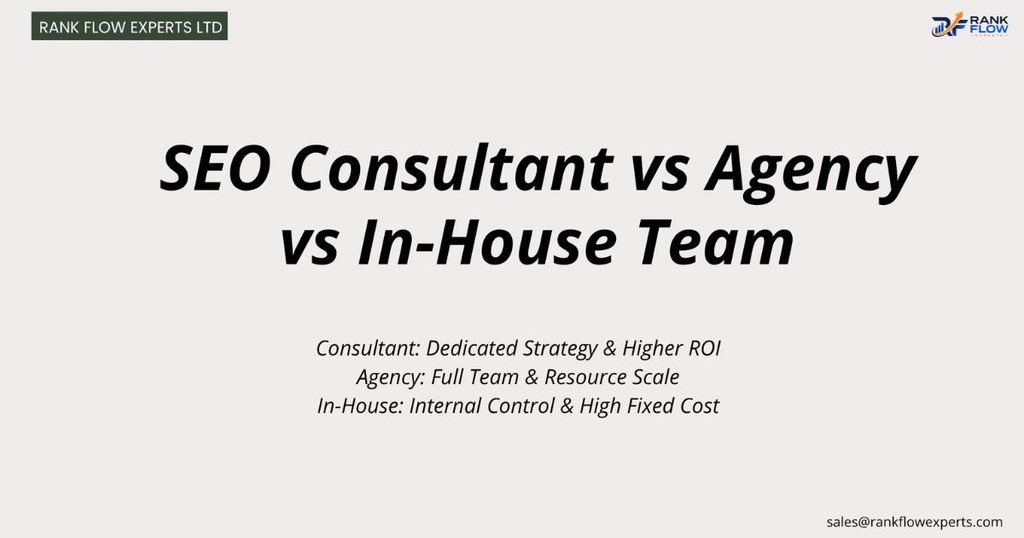
An independent consultant, an Ecommerce SEO agency, and an internal team can all support organic growth. The main difference is how they deliver the work and who manages it. Consultants often provide focused expertise, agencies offer broader services, and internal teams work closely with your products, developers, and marketing operations.
Your decision should reflect your budget, workload, and business goals. A consultant may be enough when you need expert guidance on a specific problem. An agency may suit ongoing work across several disciplines, while an internal team can provide continuous support when SEO is central to your business. Some retailers combine these models to balance specialist knowledge with execution capacity.
Independent Ecommerce SEO Consultant
An independent consultant can offer direct access to specialist knowledge without requiring a large agency engagement. This arrangement may suit businesses that already have developers, writers, and marketers who can implement recommendations. It can also work well for focused projects, such as diagnosing indexation problems or reviewing a planned migration.
However, one person cannot handle every task at once. Availability, specialist coverage, and implementation capacity may be limited. Before hiring, ask whether the consultant provides hands-on support or primarily advises your team. Clear expectations will help you decide whether the arrangement matches your workload.
Ecommerce SEO Agency
An agency may bring together technical SEO specialists, content strategists, analysts, and outreach professionals. This can be useful when your store needs several services at the same time. A suitable agency can coordinate an ongoing program and provide support across different areas of search optimization.
The trade-off is that costs and service quality vary. You should understand who manages your account, who performs the work, and how much access you will have to senior specialists. Review the proposed deliverables carefully. A larger team does not automatically mean better results.
In-House Ecommerce SEO Team
An internal team develops a deeper understanding of your products, customers, and business priorities. Team members can work closely with merchandising, development, customer support, and marketing. This arrangement may suit established retailers with continuous optimization needs and enough resources to support specialist roles.
However, hiring and managing an internal team takes time and money. Recruitment, training, software, and coordination all contribute to the total cost. Some businesses therefore hire a consultant to guide strategy while internal staff handle implementation. This hybrid approach can provide expertise without outsourcing every decision.
Comparing the Three Options
| Factor | Independent consultant | SEO agency | In-house team |
| Main strength | Focused expertise | Broader service capacity | Business knowledge |
| Implementation | Depends on scope | Often available | Depends on staffing |
| Flexibility | Often high | Contract-dependent | Internal priorities |
| Management | Coordinate with one specialist | Manage the agency relationship | Manage employees and workflows |
| Suitable for | Defined challenges | Ongoing external support | Continuous internal optimization |
Conclusion: Finding the Best Ecommerce SEO Consultant in 2026
Finding the right consultant requires more than comparing names and prices. You need someone who understands ecommerce, can explain their recommendations clearly, and has experience relevant to your store. The right choice should reflect your technical needs, business goals, and ability to implement the proposed work.
Before making a decision, review the provider’s evidence, confirm the scope, and agree on realistic measures of success. Whether you hire an independent specialist, work with an agency, or develop an internal team, focus on useful deliverables and accountable execution. A strong SEO partnership should help you make better decisions, improve product discovery, and build sustainable organic growth over time.
Ready to Scale Your Ecommerce Store with Expert SEO?
Finding the right ecommerce SEO consultant can transform your organic visibility and drive consistent, revenue-generating traffic. At Rank Flow Experts, we create tailored SEO strategies that optimize your product pages, fix technical roadblocks, and double your sales.
An ecommerce SEO consultant identifies ways to improve search visibility and attract relevant shoppers. Their work may include technical audits, keyword research, product page improvements, category optimization, content planning, and performance measurement. Some consultants also implement changes, while others provide recommendations for your internal team.
A comprehensive audit should examine crawling, indexing, site architecture, keyword targeting, product and category pages, internal links, structured data, and performance. It should also identify important risks and prioritize recommendations. The final report should explain what needs fixing, why it matters, and how to measure progress.
A Shopify SEO consultant may be a good fit when your main challenges involve Shopify themes, product templates, apps, or platform-specific settings. A broader ecommerce specialist may suit stores with complex technical issues or several platforms. Choose based on relevant experience and the problem you need to solve.
SEO results vary with competition, website condition, implementation speed, and the type of changes made. Some technical improvements can produce earlier signs of progress, while competitive rankings may take longer. Review performance over time and distinguish completed work from measurable business outcomes.
Neither option is automatically better. A consultant may provide focused strategic guidance, while an agency may offer a broader team for ongoing execution. Your decision should depend on the work required, your internal resources, and the level of support included in the agreement.